
A moving truck is a workshop. The tailgate is its bench, the ramp is its most-used tool, and both of them assume one thing the steep grid refuses to provide: level ground. Everything below follows from that.
Rule one: the truck arrives at the top
The approach route matters before the standing does. Coming in from the ridge side means the truck reaches the crest of your street empty of drama: no loaded climb, no hill start with two tonnes of your furniture aboard, no three-point turn on a 30% pitch with a stone wall on each side.
On Awaba-grade streets that usually means we drive past the top of your street and come back to it, rather than charging up from the beach end. It looks indirect on a map. It's the professional line.
Rule two: crest or landing, never nose-down on the pitch
The standing position is the flattest ground within a workable carry of your door: the crest, a driveway apron, one of the landings where the street takes a breath. Wheels get chocked before the doors open, and the tailgate points at the carry line, not the view.
What we won't do is park nose-down on the steep pitch because it's ten metres closer. A ramp run off a tilted deck steepens with the street; furniture on a trolley develops opinions of its own; and the crew spends the day fighting the truck instead of moving your house. Ten extra metres of level carry beats all of it.
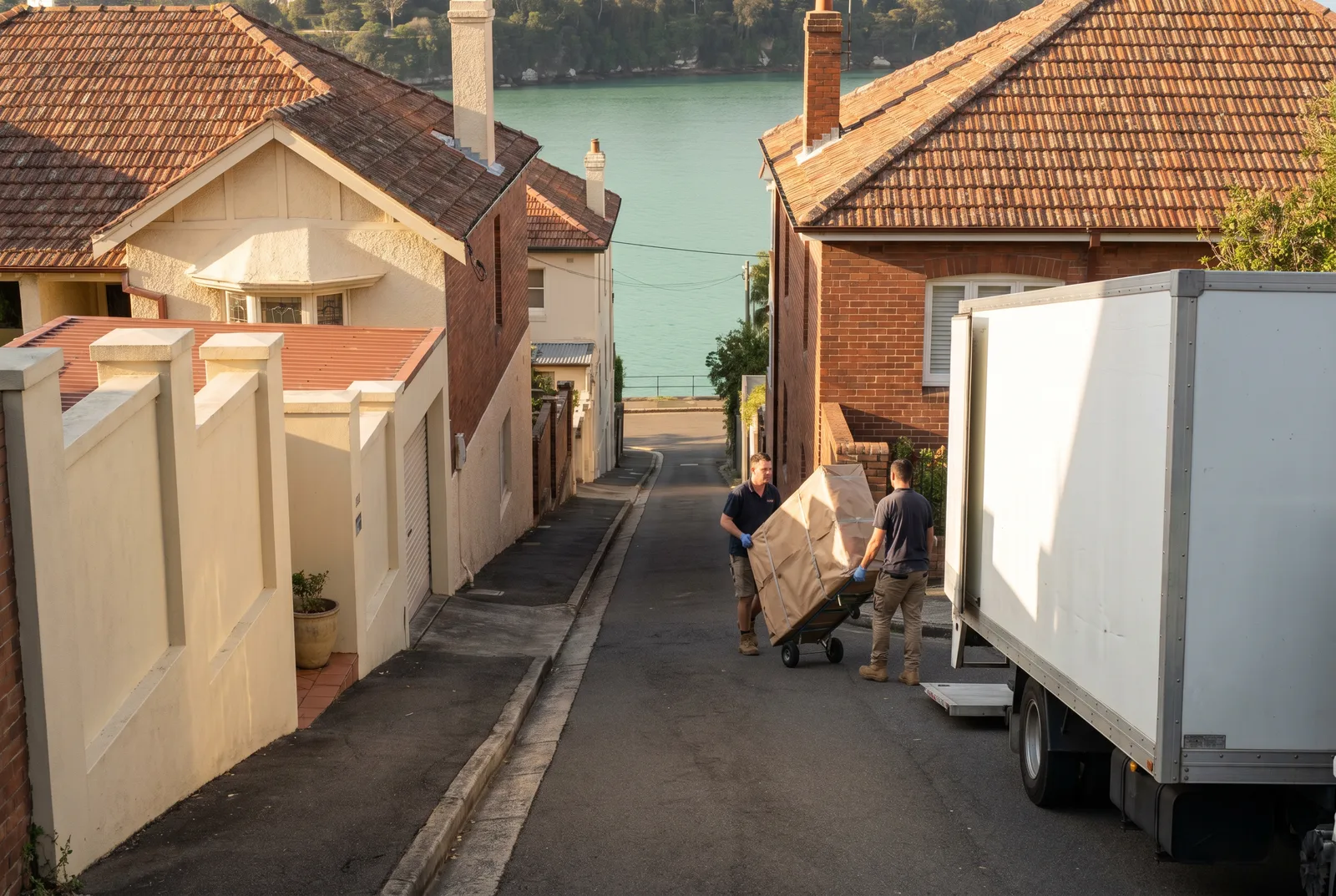
Rule three: the carry runs downhill
Given any choice at all, loaded legs go down and empty legs go up. Carrying a wardrobe downhill, the hill helps: gravity does part of the work and the carriers control the pace. Carrying it uphill, every kilogram is lifted twice, once by muscle and once by gradient, and the crew that starts strong at 7am is spent by ten.
Which side of your house the truck takes depends on which way the furniture is flowing. Delivering in, it stands above you and the loaded legs run down to your door; moving you out, we'll often stand on the low side so the heavy carries fall toward the tailgate instead of away from it. The Climb Sheet on our home page draws this for your part of the bowl; it's the same logic we run on the callback, just faster.
What this means for your quote
When you enquire, three details turn a generic estimate into a real plan:
- Your street and roughly where on it you are: top third, middle, bottom. That sets the approach and the likely standing.
- What sits between the kerb and your door: garden steps, a shared path, a driveway too steep to trolley. That sets the carry legs.
- Your biggest, heaviest and most awkward pieces. They set the crew size, because they set how many hands each carry leg needs.
With those three, the hours we estimate are hours the day actually takes. Without them, anyone's number, ours included, is a guess wearing a suit.
In from the ridge, stand at the crest, chock the wheels, carry downhill, count the garden steps before quote day. That's a steep-street move in one sentence.